
Some weeks the phone rings all day. Other weeks, you check your ad account, your inbox, and your call log and wonder where the work went. The jobs that do come in are often the wrong fit. Small repair calls when you want full installs. Price shoppers. People outside your service area. Leads that drain admin time and never turn into revenue.
That’s not a traffic problem. It’s a lead acquisition marketing problem.
Contractors don’t need more random clicks. They need a system that pulls the right searcher in, gets them to raise their hand, and moves them to an estimate, a booked job, and a paid invoice. The shops that stay busy don’t rely on one tactic. They connect positioning, landing pages, local SEO, paid traffic, and follow-up into one pipeline.
Strategic Roadmap for Contractor Lead Generation
- Stop Chasing Leads and Start Building a System
- Find Your Best Customers Before They Find You
- Build a Landing Page That Books Jobs
- Dominate Local Search for a Free Flow of Leads
- Use Paid Ads for Immediate and Scalable Lead Flow
- The Simple Follow-Up System That Closes Deals
Stop Chasing Leads and Start Building a System
If your marketing depends on luck, you’ll keep getting lucky at the wrong times.
A proper system does three things. It attracts the right prospect, converts that prospect on your site, and moves the lead into follow-up fast enough to win the job. Miss any one of those and the whole thing gets expensive. You can rank well and still lose leads with a weak page. You can buy clicks and still lose money with poor qualification. You can generate inquiries and still stay stuck if nobody follows up properly.
Here is why this matters:
- Traffic without targeting brings the wrong jobs.
- Forms without structure scare good prospects away.
- Leads without follow-up turn into wasted spend.
- Reporting without attribution makes every decision feel like a guess.
The contractors that break the feast-or-famine cycle stop thinking in channels and start thinking in flow. Search term to landing page. Landing page to form or call. Call to estimate. Estimate to booked work.
Practical rule: If you can’t trace a lead from first click to sold job, you don’t have a lead generation strategy. You have activity.
That’s why the foundation matters more than the tactic of the month. Before changing ad creative, posting more on social, or paying for another marketing tool, tighten the system. For construction and trades businesses, that starts with customer fit, service-page intent, local search visibility, and response speed. If you want a broader view of that foundation in the trades space, this breakdown of construction marketing strategies is a useful companion.
Find Your Best Customers Before They Find You
Most contractors describe their audience too loosely. “Homeowners in Ontario” isn’t a target. It’s a map.
Lead quality falls apart before the campaign even starts. Only 27% of marketing leads meet sales criteria, often because marketing and sales define a qualified lead differently. A clear Ideal Customer Profile helps fix the 41% misalignment and filters out the 73% of leads that would otherwise fail to convert, according to Landbase’s lead scoring statistics.
Start with the jobs you want
Open your past jobs, not your assumptions.
Look at your most profitable work and sort it by a few practical filters:
Job type
Emergency repair, replacement, planned renovation, maintenance, or commercial service. These buyers behave differently. Which means you should build separate pages and offers for each.Location
Your best customer might not be “anywhere nearby.” It might be a tighter cluster of postal codes where your crews already work efficiently. Which means you should stop paying to attract leads from places you don’t want to serve.Project value
A company chasing full basement renovations shouldn’t use the same message as a plumber chasing same-day service calls. Which means your page headline, photos, and call-to-action need to reflect the job value you want.Decision trigger
Some people need help now. Others research for weeks. Which means your lead acquisition marketing should match urgency. Emergency pages should focus on speed and trust. Renovation pages should focus on process, proof, and next steps.
Build an ICP from real signals
You don’t need a giant research budget for this. Use the tools you already have.
A practical ICP for a contractor pulls from:
- Google Analytics to see which service pages attract visits and where people drop off
- Search Console to find queries
- Google Business Profile insights to spot the services generating calls
- Your estimate log to identify which leads close and which ones waste time
- Call recordings or notes to hear the exact words buyers use
Create a one-page profile for each profitable audience segment. Include:
- Primary service need
- Location
- Urgency level
- Typical objections
- Questions they ask before booking
- Red flags that signal a poor fit
A roofing company might end up with two different ICPs. One is the homeowner searching after storm damage. The other is the homeowner planning a full replacement and comparing materials. Those are not the same lead. Treating them the same is how ad budgets disappear.
The better your ICP gets, the less you need to “improve lead quality” later. You’ve already done the filtering upstream.
Use forms to pre-qualify before the call
Many contractor sites fail here. They ask for contact info too soon and learn too little.
A better move is to use your form to screen for fit without making the process feel like work. Ask questions that tell you whether the lead belongs in your pipeline. Service needed. Property type. Area served. Desired timing.
Pro tip: Use a multi-step form instead of one long list of fields. Start with low-friction questions, then ask for industry or project details, and ask for contact information last. By that point, the visitor has already invested effort, so finishing feels natural.
That same structure helps your office team prioritise callbacks. A lead saying “full kitchen renovation” in your service area is not the same as a lead asking for a small handyman task three towns away.
Build a Landing Page That Books Jobs
A contractor landing page has one job. Get the right person to take the next step.
Too many pages try to do everything at once. They explain the company history, list every service, show a giant menu, and send people wandering. That’s not a sales page. It’s a brochure with leaks.
For contractors in Canada, mobile performance matters most. 91% of consumers search for local services via mobile, and for Ontario contractors, a mobile-optimised landing page that answers the query directly converts at an average of 2.35%. A top Google ranking is also directly correlated with a 14.6% close rate on those leads, according to this Canadian lead automation and generation guide.
Make the page answer one search intent
A good landing page doesn’t try to speak to everybody. It matches one search.
If someone searches “emergency plumber Barrie,” the page should immediately confirm three things:
- You offer that exact service
- You serve that exact area
- There’s a clear next action
Your headline should do the heavy lifting. Skip vague lines like “Quality Service You Can Trust.” Say what you do and where you do it.
Then support it with the right proof:
- Before-and-after images for visual trades
- Review excerpts tied to the service
- Short copy blocks on process, timing, and what happens next
- A call button and form above the fold
Which means you should build separate pages for separate services instead of pushing every visitor to one generic contact page.
Reduce exits and lower friction
Most landing pages lose leads through distraction, not traffic volume.
Strip out the main navigation on campaign pages. If someone came from Google Ads or a specific local search, don’t give them six escape routes. Keep the focus on the action you want. Call. Form fill. Quote request.
A few practical fixes work well:
- Remove the full site menu on paid traffic pages
- Keep one primary call-to-action repeated down the page
- Use trust elements near the form, not buried in the footer
- Answer common objections early, such as service areas, response times, or project types
There’s a place for broader education too. But not on a page meant to convert now. If you’re also promoting educational content through social channels, keep it separate from your service conversion path. This piece on effective hashtag strategies to increase reach shows how awareness content serves a different purpose than a bottom-of-funnel landing page.
In practice, a better contractor form flow
Use this simple sequence.
Step one asks for the service
“What do you need help with?” Keep it easy. Emergency plumbing, roof replacement, kitchen renovation, electrical upgrade.Step two gathers useful detail
Ask one or two fit questions. Property type. Project timing. Service area. Keep it relevant.Step three asks for contact information
Name, phone, email. Nothing more unless your team needs it.
That structure lowers cognitive load. It also improves handoff quality because your team gets context before picking up the phone.
A solid page doesn’t need clever copy. It needs clarity, proof, and less friction.
Dominate Local Search for a Free Flow of Leads
Paid traffic is useful. Organic local search builds the asset.
When your business shows up in the local pack, your service page ranks, and your reviews support the click, you stop buying every lead from scratch. That’s the strong advantage of local SEO for contractors.
For Ontario contractors, recent data projects that Google Ads CPL can be 3x higher at $45 than organic SEO leads at $15 following algorithm shifts. The same source says 55% of local searches in the GTA are now voice-driven, and “near me” searches have seen a 32% year-over-year increase in volume. Those figures come from this lead acquisition strategy analysis.
Own the map pack before you chase broader traffic
Start with your Google Business Profile.
For many trades, the map pack is the first thing a prospect sees. If your profile is incomplete, inconsistent, or weak on reviews, you’re losing trust before they even click your site.
Focus on the basics:
- Choose the right primary category
- Keep service areas accurate
- Add service descriptions that match what you sell
- Upload current jobsite and team photos
- Collect reviews tied to real jobs and locations
Which means you should treat your Google Business Profile like a lead channel, not a directory listing.
Build city and service pages that match how people search
A strong local SEO structure comes down to service + location.
Not one generic “Services” page. Separate pages such as roofing in Barrie, plumbing in Innisfil, kitchen renovations in Newmarket, or electrical panel upgrades in Alliston. These pages should use natural local language, show relevant work, and answer local buying questions.
A simple page build looks like this:
| Page type | Purpose | What to include |
|---|---|---|
| Core service page | Rank for the service itself | Scope of work, proof, FAQs, call-to-action |
| City page | Rank in a target service area | Local references, areas served, relevant reviews |
| Problem page | Capture urgent intent | Specific issue, timeline, fast contact options |
That structure gives Google clearer relevance signals. Which means you should stop forcing every keyword into one page and start mapping one topic to one page.
If your rankings have stalled, the problem is often structure and intent mismatch, not effort. This article on why 2025 SEO fails and how to fix it before your traffic tanks is useful if you’re seeing impressions without calls.
Reviews and voice search decide who gets the call
The click often goes to the business that looks easiest to trust.
Reviews do part of that work. So does how closely your content matches spoken searches. Voice search queries are longer and more natural. People say, “Who fixes leaking flat roofs near me?” not just “flat roof repair”.
That changes how you write service pages and FAQs. Use the phrases customers say on calls. Answer practical questions directly. Keep location language natural. Add short FAQ sections for service areas, response times, and common job types.
Don’t chase “traffic”. Chase the search that leads to a booked estimate in the area you want.
Local SEO compounds. Ads stop when spend stops. Rankings keep working if the structure is sound.
Use Paid Ads for Immediate and Scalable Lead Flow
A crew opens up next week, trucks are sitting, and the phone is quiet in the exact area you want to grow. That is the moment paid ads earn their keep.
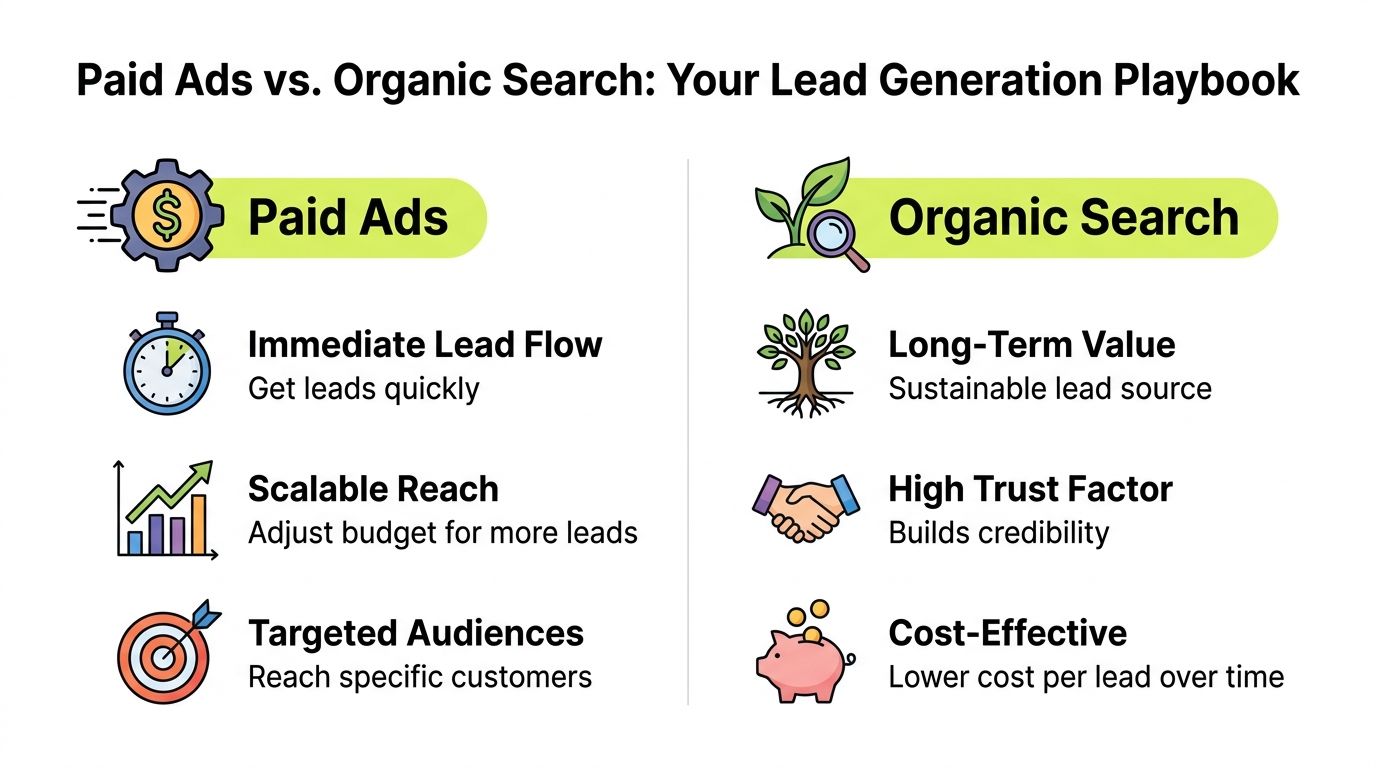
SEO builds long-term demand. Paid ads let you turn specific demand on by service, town, and season. For Ontario contractors, that matters because lead quality shifts fast. Ice dam calls, summer AC installs, emergency plumbing, and commercial maintenance all behave differently. A campaign that works for an urgent residential repair can waste money on a long-sales-cycle commercial offer.
One useful benchmark in Canadian trades is that content marketing strategies generate 3x more leads than traditional outbound marketing at 62% lower cost, and LinkedIn can source 80% of B2B leads in Canada, according to The Insight Collective’s B2B demand generation stats. Use that as a planning signal. Ads should support the system, not carry the whole load on their own.
When paid traffic makes sense
Paid ads make sense in three situations.
The first is speed. If you have capacity to fill, a new service line to launch, or a nearby town to enter, Google Search and Local Services Ads can produce calls far faster than waiting for rankings to catch up.
The second is control. Paid traffic lets you choose the service, location, device, schedule, and message. That matters when margins are tight and you do not want to pay for clicks outside your service radius. It also matters for trades with clear job value differences. A company chasing full panel upgrades should not run the same campaign setup as one chasing small handyman electrical calls.
The third is testing. Before building out months of new location pages or service content, run ads to see which combinations of offer, geography, and intent turn into estimates and signed work. That saves time and content budget.
In practice, the strongest setup is mixed. Use ads for immediate demand and use organic search to lower acquisition costs over time.
Paid lead channels for contractors at a glance
| Channel | Best For | Typical CPL (Cost Per Lead) | Lead Quality |
|---|---|---|---|
| Google Search Ads | Urgent, high-intent service searches | Varies by market and keyword | Usually strong if keywords and landing pages are tightly matched |
| Google Local Services Ads | Call-driven local service inquiries | Varies by trade and area | Often strong for local residential demand |
| Facebook and Instagram Ads | Awareness, retargeting, renovation inspiration | Varies by audience and offer | Mixed. Better with strong creative and a specific offer |
| LinkedIn Ads | Commercial trades, partnerships, high-ticket B2B services | Varies by niche | Often stronger for specialised B2B targeting |
That table is a starting point, not a media plan.
Google Search Ads usually win for urgent service categories. Someone searching “emergency plumber Mississauga” or “flat roof repair Toronto” already wants help. Your job is to match that search with the right page, the right promise, and a fast path to call.
Google Local Services Ads can work well for residential trades where homeowners want a quick shortlist and a phone number. They are less useful when your sales process needs education, detailed scoping, or a site visit before pricing.
Facebook and Instagram are usually weaker for cold lead capture in home services, but they can be profitable for retargeting, renovation offers, and before-and-after driven services. I use them more to stay in front of people who already visited the site than to hunt for bottom-of-funnel emergency leads.
LinkedIn is the outlier. For commercial HVAC, facility maintenance, electrical contracting, or specialised B2B work, it can filter out a lot of junk because you can target by role and company type. Clicks cost more. Lead quality can justify it.
Boost Local Business is one example of a provider that handles conversion-focused websites, Google Ads, SEO, and ongoing site management for contractors that do not want to run the stack in-house.
Lead with value, not with a generic quote request
Weak offers sink paid campaigns faster than bad targeting.
“Request a Quote” works only when trust is already high and urgency is obvious. In every other case, it asks too much too early. A better first step gives the homeowner or property manager a clear reason to respond now.
For contractors, that usually means a practical offer tied to the actual job:
- Roof inspection request
- Drain issue diagnostic
- Renovation planning checklist
- Electrical safety review
These offers work because they lower commitment while still attracting real buying intent. They also help sort lead quality. Someone who asks for a drain diagnostic is usually closer to action than someone who clicks a generic ad and lands on a broad homepage.
The trade-off is volume versus quality. Broader offers can bring in more form fills. Tighter offers usually produce fewer leads, but more of them turn into booked estimates and paid jobs. In Canadian home services, that is usually the better bet.
The Simple Follow-Up System That Closes Deals
Most lead generation problems are follow-up problems wearing a traffic disguise.
You can do everything right up to the form fill and still lose the work because the callback came too late, the message was vague, or the sequence ignored Canadian compliance rules. In Ontario, 68% of marketers cite privacy compliance as a top barrier, and non-compliant SMS or email nurturing has led to major penalties, including a $500K penalty for one HVAC firm. The same source notes that zero-party data strategies can produce 2.5x higher qualification rates, based on this overview of emerging lead acquisition tactics.

Speed wins, but only if your process is compliant
Fast follow-up matters. So does permission.
If you’re using forms, SMS, or automated email, build the consent into the lead capture step. Make it clear what the person is agreeing to receive. Keep records. Don’t bolt compliance on later after the campaign is already live.
Which means you should prefer zero-party data whenever possible. Ask the lead directly what they need. Let them choose the service, timing, and preferred contact method. That improves qualification and keeps your process cleaner.
If your follow-up system depends on contacts you can’t legally or confidently message, it isn’t an asset. It’s a liability.
A simple follow-up workflow you can run this week
This doesn’t require a complex CRM on day one. A lightweight stack works.
Use tools like CallRail for call tracking, HubSpot or a simple CRM for pipeline stages, and Google Sheets if you need a basic backup log. The key is consistency.
Run the workflow like this:
Lead comes in
Website form, phone call, Google Business Profile call, or ad lead form.Immediate acknowledgement goes out
Send a short confirmation by the channel they approved. Example: “Thanks for reaching out about your roofing project. We’ve received your request and will contact you shortly.”Internal alert notifies the right person
Office manager, estimator, or dispatcher gets the lead with service type and location.First human contact happens fast
The callback should not wait until the end of the day if the lead is active now.Lead status gets updated
New, contacted, estimate booked, estimate sent, won, lost.No-response sequence starts
If they don’t answer, follow up again with a clear, useful message. Keep it short and relevant.Nurture only the leads that fit
Not everyone should stay in the pipeline. Poor-fit leads should be closed out. Good-fit but not-ready leads should get occasional helpful follow-up.
Print this checklist and use it daily
Check source quality
Know whether the lead came from SEO, Google Ads, referrals, or another source.Confirm fit early
Service type, location, urgency, and project scope should be clear before your team spends too much time.Respond with context
Mention the service they asked about. Generic replies feel automated in the worst way.Track every outcome
Booked estimate, no show, sold, lost. If you don’t log outcomes, you can’t improve lead acquisition marketing.Review lost leads weekly
Look for patterns. Slow response, wrong areas, weak offer, pricing mismatch, or bad handoff.Protect compliance
Keep opt-ins clear for SMS and email. Make sure your team knows the rules before automating anything.
The contractors who win consistently don’t just generate leads. They build a system that attracts qualified demand, converts it cleanly, and follows up without delay. That’s what turns marketing from an expense line into a production tool.
If you want help building that system, Boost Local Business works with contractors and local service companies across Canada on the pieces that matter most: conversion-focused websites, local SEO, paid campaigns, website management, and the tracking needed to turn clicks into booked jobs.